
Appearance
Languages & Localization
WPfaker generates fake content that respects regional conventions, language-specific formatting, and locale-appropriate naming patterns. Rather than producing generic English-only lorem ipsum, WPfaker can create content that looks and feels native to 13 different locales. This is essential for testing multilingual WordPress sites, verifying theme compatibility with non-Latin character sets, and producing realistic demo content for clients in different countries.
The locale setting affects virtually every aspect of generated content. Post titles are constructed using words and structures appropriate to the selected language. Body content uses locale-specific text generation. Author names follow the naming conventions of the selected region. Taxonomy terms are generated in the target language. Addresses conform to country-specific formats, including street naming conventions, postal code structures, and state or province designations. Phone numbers match local formatting patterns, and financial data like IBAN numbers and currency formats follow the standards of the selected country.
Supported Locales
WPfaker supports the following 13 locales, each powered by the corresponding FakerPHP locale provider.
English (en_US)
English is the default locale and provides the broadest data coverage. Generated names follow American naming conventions (John Smith, Emily Johnson), addresses use US street formats with five-digit ZIP codes, and phone numbers follow the (XXX) XXX-XXXX pattern. This locale is the safest choice when you are not targeting a specific region, as its FakerPHP provider has the most extensive data sets.
German — Germany (de_DE)
The German locale for Germany generates names like Hans Mueller, Petra Schneider, and Klaus Weber. Addresses follow the German format with street names first and house numbers second (Hauptstrasse 42), use five-digit postal codes (PLZ), and include German city names. Company names use suffixes like GmbH, AG, and KG. Phone numbers follow the German formatting with area codes. IBAN numbers conform to the DE format.
German — Switzerland (de_CH)
The Swiss German locale generates names and addresses following Swiss conventions. Addresses use Swiss four-digit postal codes and city names drawn from Swiss geography. Company names include Swiss-specific suffixes like AG, GmbH, and Genossenschaft. Phone numbers follow Swiss formatting patterns. IBAN numbers conform to the CH format. This locale shares much of its data with de_DE but uses Switzerland-specific address and formatting rules.
German — Austria (de_AT)
The Austrian German locale generates names and addresses following Austrian conventions. Addresses use Austrian four-digit postal codes and city names drawn from Austrian geography. Company names include Austrian-specific suffixes. Phone numbers follow Austrian formatting patterns. IBAN numbers conform to the AT format. Like de_CH, this locale shares core data with de_DE but applies Austria-specific regional rules.
French (fr_FR)
The French locale generates names following French conventions (Jean Dupont, Marie Laurent, Pierre Moreau). Addresses use the French format with number first, followed by street type and name (12 Rue de la Paix). Postal codes are five digits, and city names are drawn from French geography. Company names include suffixes like SARL, SA, and SAS. Phone numbers follow the French 10-digit format.
Spanish (es_ES)
Spanish locale generation produces names with typical Spanish double surnames (Juan Garcia Lopez, Maria Rodriguez Martinez). Addresses follow Spanish formatting conventions with street types like Calle, Avenida, and Plaza. Postal codes are five digits, and cities are drawn from Spanish geography. Company suffixes include S.L., S.A., and S.L.U. Phone numbers match Spanish formatting patterns.
Italian (it_IT)
The Italian locale generates names like Mario Rossi, Giulia Bianchi, and Luca Ferrari. Addresses follow Italian conventions with street types like Via, Piazza, and Corso. Postal codes are five-digit CAP codes, and cities include Italian municipalities. Company names use suffixes like S.r.l., S.p.A., and S.n.c. Phone numbers follow Italian formatting with regional prefixes.
Dutch (nl_NL)
Dutch locale generation produces names following Netherlands conventions (Jan de Vries, Pieter van den Berg, Anna Bakker). Addresses use Dutch formatting with street names, house numbers, and postcode-letter combinations (1234 AB). City names are drawn from Dutch geography. Company names include Dutch suffixes like B.V. and N.V. Phone numbers follow the Dutch 10-digit format.
Polish (pl_PL)
The Polish locale generates names with Polish character patterns (Jan Kowalski, Anna Nowak, Piotr Wisniewski). Addresses follow Polish conventions with street types like ulica (ul.) and aleja (al.). Postal codes use the Polish XX-XXX format, and city names are drawn from Polish geography. Company names include Polish suffixes, and phone numbers match the Polish 9-digit format. This locale properly handles Polish diacritics (accented characters), which is important for testing theme character encoding support.
Portuguese — Brazil (pt_BR)
Brazilian Portuguese generates names following Brazilian naming conventions (Jose Silva, Maria Santos, Pedro Oliveira). Addresses use Brazilian formatting with street types like Rua, Avenida, and Travessa. Postal codes follow the Brazilian CEP format (XXXXX-XXX), and city names are drawn from Brazilian geography. Company names use suffixes like Ltda and S.A. Phone numbers follow Brazilian formatting with DDD area codes.
Japanese (ja_JP)
Japanese locale generation produces names using kanji characters in the traditional surname-first order, such as Tanaka Taro (田中太郎) and Suzuki Hanako (鈴木花子). Addresses follow Japanese formatting conventions with prefecture, city, ward, and block number structure. This locale is essential for testing theme support for CJK (Chinese-Japanese-Korean) characters, including proper line breaking, font sizing, and layout behavior with ideographic text.
Russian (ru_RU)
The Russian locale generates names using Cyrillic characters following Russian naming conventions, including patronymics (Ivan Ivanovich Petrov, Anna Sergeevna Kuznetsova). Addresses use Russian formatting with city, street, and building structure. Postal codes follow the six-digit Russian format. Company names include suffixes like OOO and ZAO. Phone numbers match Russian formatting with the +7 country code. This locale is valuable for testing theme support for Cyrillic character sets, including proper font rendering and text layout.
Chinese (zh_CN)
Simplified Chinese locale generation produces names using common Chinese characters, such as Zhang Wei (张伟) and Wang Fang (王芳). Addresses follow mainland Chinese formatting with province, city, district, and street structure. Like Japanese, this locale is critical for verifying that your theme correctly handles CJK characters, including text rendering, search functionality, and responsive layout with variable-width characters.
INFO
The data generated for each locale comes from FakerPHP's locale providers. Some locales have more extensive data sets than others. English (en_US) has the most comprehensive coverage, while some regional locales may fall back to their parent locale for certain data types. For example, some locales might use parent locale data for categories that have no region-specific variant.
Auto Locale Detection
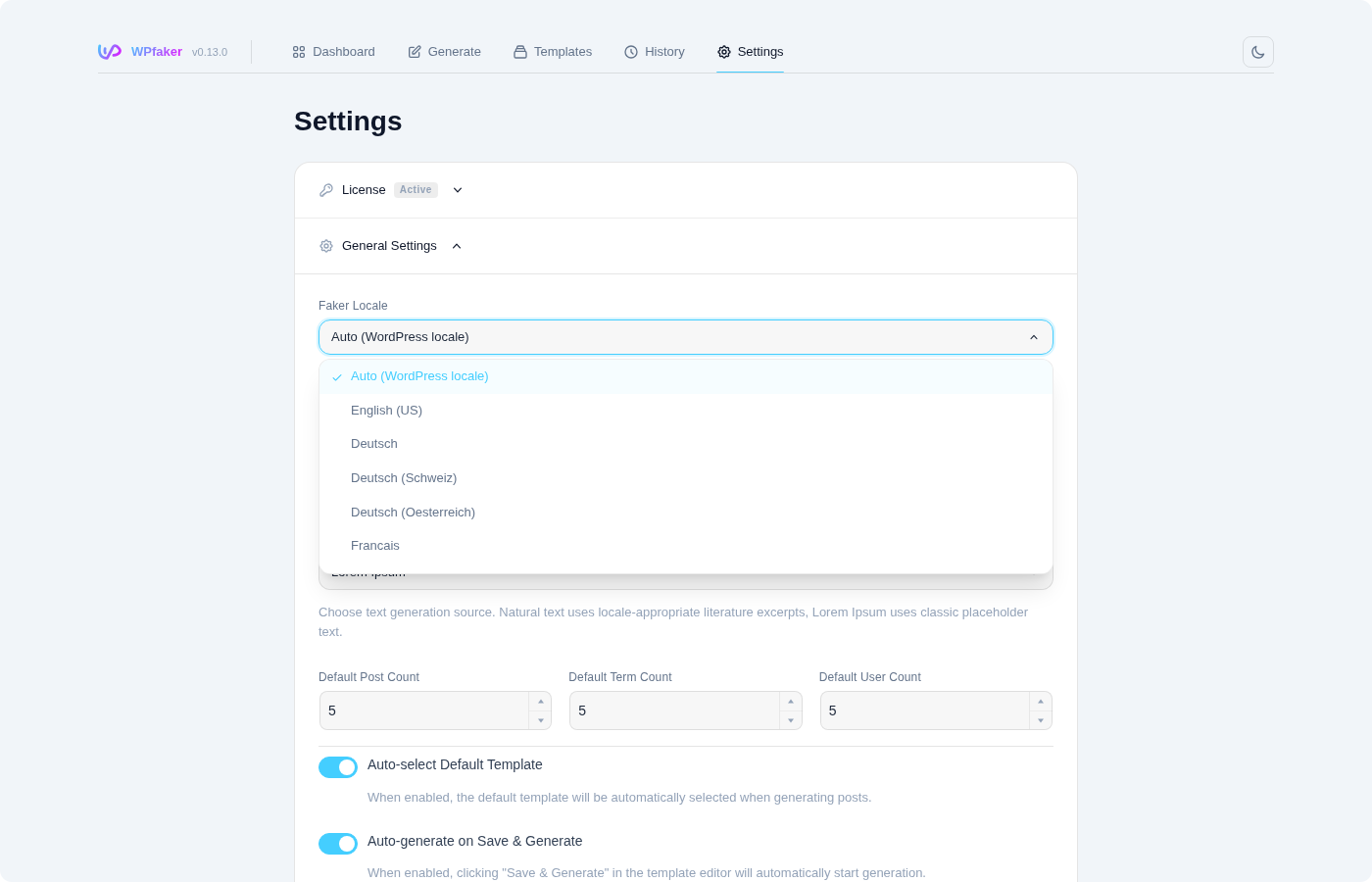
The Auto locale option, available in Settings and in the template editor, reads your WordPress site language setting and maps it to the closest supported faker locale. If your WordPress site is configured for German (de_DE) under Settings > General > Site Language, the Auto option will automatically use the de_DE faker locale for content generation.
This mapping works for all 13 supported locales. If your WordPress language does not have a direct match among WPfaker's supported locales, the Auto option falls back to English (en_US). For example, a WordPress site set to Korean (ko_KR) would fall back to English since Korean is not currently among the supported faker locales.
Auto detection is the recommended setting for most users because it keeps your generated content consistent with your WordPress language configuration without requiring manual selection.
Per-Template Locale
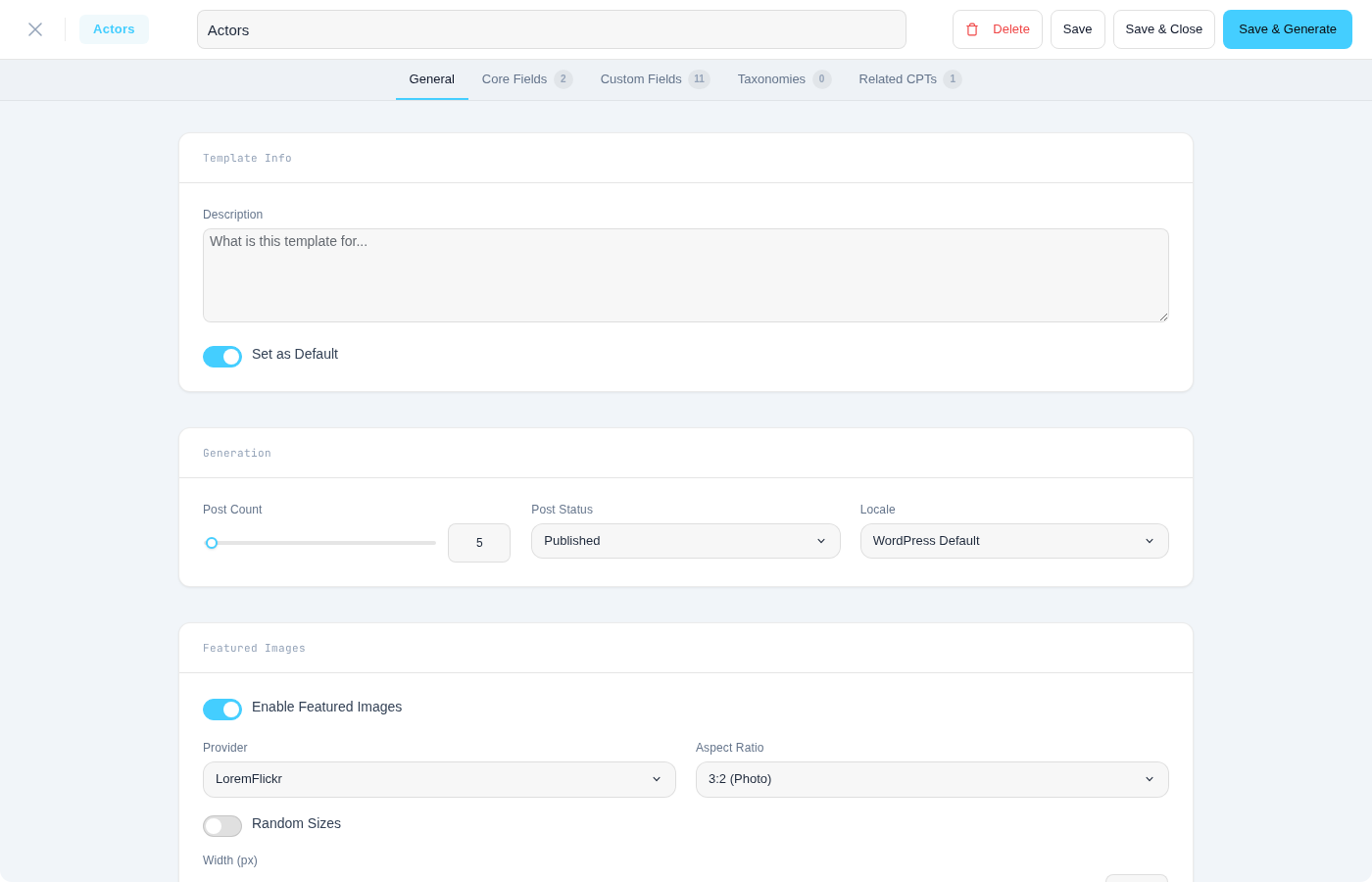
Each template can specify its own locale in the General Settings tab. This lets you create separate templates for different languages — for example, a "Blog Posts (DE)" template with the de_DE locale and a "Blog Posts (EN)" template with en_US. When you select a template on the Generate page, its locale is used for that generation run.
TIP
To create a multilingual test site, create templates with different locales and generate content with each one. For example, generate 10 posts with your English template, then switch to your German template and generate 10 more. Both batches coexist with their respective languages, giving your theme a realistic multilingual content base.
Locale-Aware Features
WPfaker's locale awareness goes beyond simple text translation. Several features adapt their behavior based on the selected locale to produce more realistic content.
Contextual Post Titles
When generating content for custom post types, WPfaker creates contextually appropriate titles that adapt to both the post type and the locale. A vehicle listing CPT generates titles like "2019 Toyota Camry LE" in English but "2021 Volkswagen Golf Comfortline" in German. A real estate CPT produces "Charming 3-Bedroom Colonial in Oak Park" in English and "Gepflegte 4-Zimmer-Wohnung in Berlin-Mitte" in German. The title generation system recognizes dozens of custom post type patterns and adjusts its vocabulary and structure accordingly.
Address Fields
Custom fields detected as address components are populated with locale-appropriate data. A field named street_address receives "123 Main Street" in en_US but "Hauptstrasse 42" in de_DE and "12 Rue de la Paix" in fr_FR. Postal codes, city names, state/province names, and country names all follow the conventions of the selected locale. This is especially important for directory sites, real estate plugins, and any application that displays address data.
Author Names
Generated user accounts receive names that match the selected locale. Generating users with the Japanese locale produces names like Tanaka Taro and Suzuki Hanako rather than John Smith and Jane Doe. The biographical descriptions, usernames, and email addresses are also constructed to be consistent with the locale's naming patterns.
Date and Number Formatting
While WordPress handles most display formatting through its own localization system, WPfaker ensures that any date strings or formatted numbers embedded in custom field data follow the conventions of the selected locale. German dates use the DD.MM.YYYY format, US dates use MM/DD/YYYY, and so on.
Adding New Locales
WPfaker's locale support is tied to the FakerPHP library's available locale providers. The current selection of 13 locales covers the most commonly requested languages for WordPress development. Additional locales may be added in future releases based on user demand and FakerPHP provider availability.
If you need a locale that is not currently supported, the Auto detection will fall back to English for unsupported WordPress languages. You can request new locale support through WPfaker Support by submitting a feature request. Priority is given to locales that have robust FakerPHP providers with comprehensive data sets for names, addresses, and phone numbers.
For complete configuration instructions on setting the global locale and understanding how it interacts with other settings, see the Settings page. For details on how locale affects the field detection system, including multilingual pattern matching across thirteen languages, see the Field Detection documentation.